
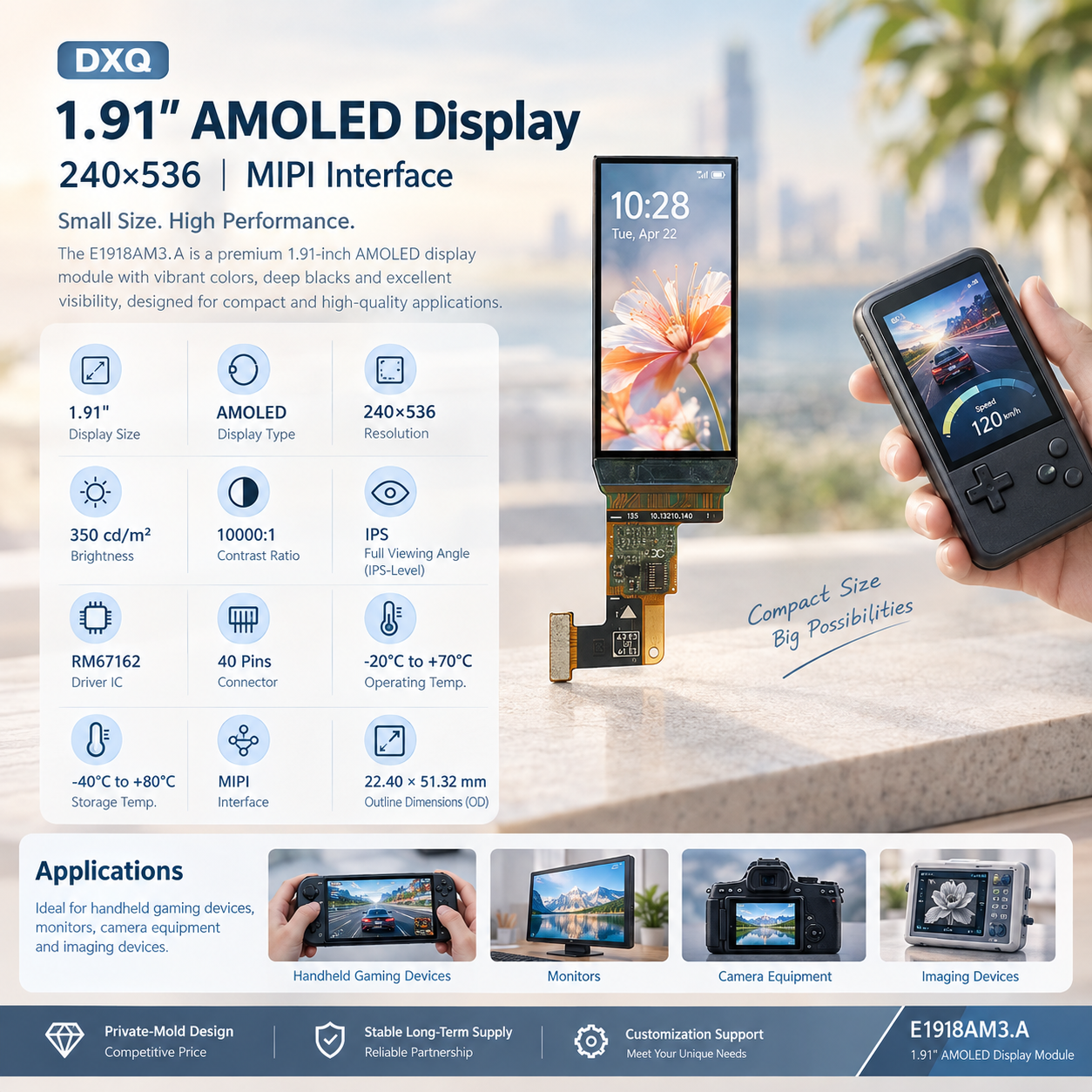
An AMOLED display manufacturer delivers compact visual solutions for modern automotive control interfaces. The E1918AM3.A 1.91-inch AMOLED display module provides rich visuals across ultra-compact vehicle cockpits. Consequently, automotive designers create sleek dashboards while satisfying strict environmental standards (lead-free compliance) easily. Explore our full range of small screens inside our protect-category catalog.
Automotive designers struggle to integrate readable gauge displays inside tight steering wheels, door handles, and gear selectors. Traditional LCD screens rely on thick backlight units, making them too bulky for micro-HMI modules. Therefore, Tier-1 automotive engineers demand lightweight, high-contrast display architectures that fit narrow spaces effortlessly.

Space Constraints in Next-Generation Cockpits
Washed-Out Black Levels on Secondary Console Gauges
Picture a motorcycle rider cruising at night while checking a small digital secondary gauge. Legacy LCD screens bleed backlight through dark areas, creating a distracting grey haze. Partnering with an AMOLED display manufacturer eliminates backlight leakage using self-emitting pixel technology. As a result, riders view crisp speed numbers against true pitch-black backgrounds.
Thermal and Space Limits in Steering Wheel Control Knobs
Engineers integrating micro displays inside rotary gear selectors face severe space and heat limits. Bulky LED backlights add unwanted thickness and trap operational heat inside tight dial housings. Utilizing a compact automotive HMI display slims down housing profiles to a tiny 22.40 x 51.32 mm footprint. Consequently, designers embed high-resolution displays directly into sleek tactile dials easily.
Excessive Power Consumption in Auxiliary Vehicle Displays
Auxiliary status screens on smart key fobs drain internal lithium batteries quickly when using standard LCDs. Continuous backlight illumination wastes electrical current even when displaying simple status icons. Deploying an ultra-high contrast OLED panel illuminates only active pixels, cutting power consumption dramatically. Thus, auxiliary vehicle controls maintain extended battery life during daily use.

Advanced OLED Engineering: The E1918AM3.A Module
The E1918AM3.A module features a vivid 240×536 resolution packed into a 1.91-inch active display area. LingC manufactures this high-performance display to withstand wide operating temperatures ranging from -20°C to +70°C reliably.
Extreme Optical Performance via 10,000:1 Contrast
The primary advantage of the E1918AM3.A display lies in its self-emissive AMOLED pixel architecture. Every individual pixel generates its own light, allowing dark pixels to turn off completely.
This architecture yields an astonishing 10,000:1 contrast ratio that far exceeds traditional automotive LCD performance. The screen renders deep blacks and vibrant colors that remain razor-sharp under diverse ambient lighting.
Furthermore, the IPS-level full viewing angle prevents color inversion across sharp side perspectives. Vehicle operators read critical battery levels and dynamic climate alerts clearly from any angle without visual distortion.
High-Speed MIPI Bus and RM67162 Controller
The integrated RM67162 driver IC communicates seamlessly through a high-speed MIPI interface protocol. Visual data transfers rapidly via a compact 40-pin connector, minimizing ribbon cable space inside crowded enclosures.
Moreover, our exclusive private-mold design guarantees stable long-term manufacturing supply for automotive production runs. Access complete physical layout dimensions inside our technical-guide manual. LingC supports custom pinouts, cover glass bonding, and driver firmware modifications.
| Technical Parameter / Feature | E1918AM3.A 1.91″ AMOLED Module | Standard Small-Sized LCD Screen |
| Display Technology | Self-Emissive AMOLED Panel | Transmissive TFT LCD with Backlight |
| Contrast Ratio | Exceptional 10,000:1 Contrast | Basic 500:1 to 800:1 Contrast |
| Black Level Quality | Pure Deep Blacks (Off Pixels) | Grey Backlight Leakage |
| Data Interface Type | High-Speed 40-Pin MIPI Bus | Legacy SPI / Parallel Interface |
| Outline Dimensions (OD) | Ultra-Slim 22.40 x 51.32 mm | Bulky Enclosure with LED Array |
| Operating Temperature | Wide -20°C to +70°C Support | Restricted 0°C to +50°C Profile |
| Power Consumption | Ultra-Low (Active Pixels Only) | High Constant Backlight Power Draw |
| Target Application | Smart Cockpits, Rotary Dials | Basic Legacy Handheld Meters |
Streamlining Compact Automotive HMI Integration
Integrating a small size AMOLED display elevates user interaction across modern vehicle cabins significantly. Imagine installing a sleek touch dial screen onto a luxury center console dashboard.
The narrow physical profile fits tight interior contours without requiring deep cutout slots. In addition, low power draw reduces thermal load inside sealed vehicle trim components during long drives.
Frequently Asked Questions
Can an AMOLED display manufacturer guarantee stable long-term supply for automotive projects?
Yes. LingC provides stable long-term component supply with private-mold production for mass manufacturing cycles.
Does the 1.91-inch AMOLED display support wide operational temperatures?
The E1918AM3.A operates reliably from -20°C to +70°C, making it suitable for automotive cabins.
How does the MIPI interface benefit small HMI designs?
The high-speed MIPI interface reduces pin counts and cable sizes while transferring high-frame-rate graphics smoothly.
Choosing an AMOLED display manufacturer like LingC ensures high-contrast visual clarity inside compact automotive spaces. Superior 10,000:1 contrast paired with low-power MIPI connectivity transforms smart cabin interfaces completely. Upgrade your display modules today to experience compact OLED innovation everywhere.



Add comment