
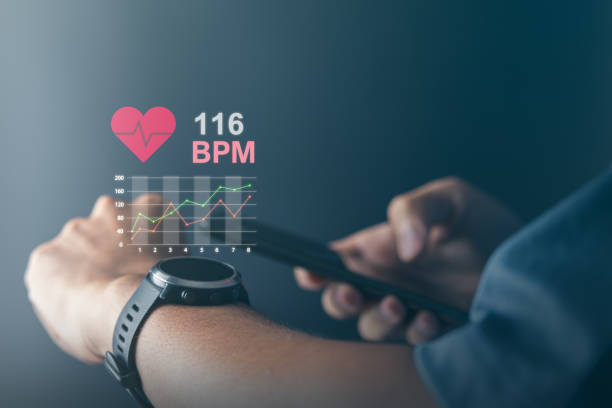
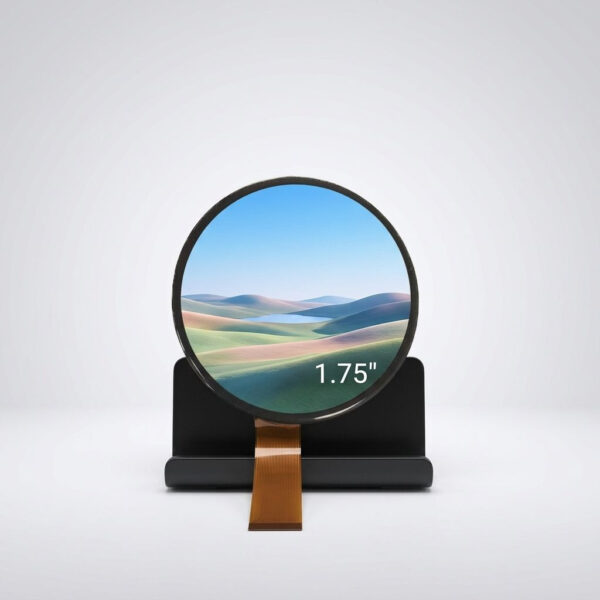
Upgrading from a traditional LCD round display to an advanced circular AMOLED panel boosts smartwatch visual clarity, cuts interface latency, and ensures perfect outdoor readability. Featuring a one point seven five inch footprint, four hundred sixty-six by four hundred sixty-six resolution, and On-Cell touch integration, this display delivers breathtaking image quality. Sourcing this high-brightness round AMOLED module offers extraordinary commercial value, enabling smartwatch brands, wearable hardware developers, and IoT manufacturers to build premium wristwear affordably today.
This advanced circular screen complies with strict hazardous substance restrictions (RoHS and CE safety standards) while providing an impressive one hundred thousand to one contrast ratio. Meanwhile, its integrated CO5300 driver IC optimizes QSPI signal routing to maximize battery longevity. As a result, wearable product engineers elevate user experience while securing reliable, budget-friendly display hardware today. Explore our complete product-category catalog to order circular AMOLED screens online now.
4 Display Limitations Hindering Next-Generation Smartwatch Performance
Wearable device engineers, fitness watch designers, and IoT developers frequently face washed-out screens, sluggish touch responses, and excessive battery drain. Legacy liquid crystal modules rely on bulky backlights that degrade color saturation and create thick bezels. Embedded hardware engineering specialists regularly identify four primary display failure points across conventional circular wearable screens.
Persistent Backlight Bleed Ruining Visual Contrast in Dark Environments
Standard liquid crystal displays require constant backlight illumination that leaks light through dark user interfaces continuously. Backlight leakage creates washed-out grey tones, obscuring fine health tracking graphics and tiny text characters in low-light settings. Consequently, smartwatch users experience dull visual contrast that undermines the premium feel of high-end wearable products. Self-emissive AMOLED pixels turn off completely, generating deep true blacks and unprecedented one hundred thousand to one contrast ratios.
Insufficient Surface Luminance Causing Severe Sunlight Readability Issues
Conventional small liquid crystal modules struggle to produce sufficient brightness output, rendering watch faces unreadable under direct afternoon sunlight. Fitness enthusiasts must shade their wrists constantly to view vital heart rate metrics or outdoor GPS navigation maps. Therefore, smartwatch brands lose competitive edge when users demand crisp, crystal-clear outdoor visibility during daytime sports activities. High-efficiency emissive layers deliver seven hundred cd per square meter brightness, maintaining vibrant UI legibility outdoors.
Bulky External Touch Panels Increasing Structural Thickness and Parallax
Traditional display assemblies attach separate capacitive touch glass over liquid crystal panels using air-gap bonding techniques. Dual-layer structures increase total module thickness significantly, creating noticeable optical parallax and sluggish touch response speeds. As a result, compact smartwatch designs suffer from bulky physical cases that feel uncomfortable on user wrists. Integrated On-Cell capacitive touch technology fuses touch sensors directly onto screen glass, minimizing module thickness to zero point eight millimeters.
Sluggish Parallel Data Buses Draining Small Wearable Batteries Rapidly
Legacy display driver architectures require complex parallel data buses that strain small microcontrollers and drain tiny lithium batteries quickly. High data pin counts force hardware designers to use larger board footprints, complicating compact smartwatch PCB layout routing. Thus, wearable manufacturers struggle to deliver sleek device profiles while maintaining multi-day battery endurance for active users. QSPI interface integration driven by the CO5300 IC streamlines data transmission, reducing system power draw drastically.
Technical Solutions: 1.75 Inch 466×466 Round AMOLED Display
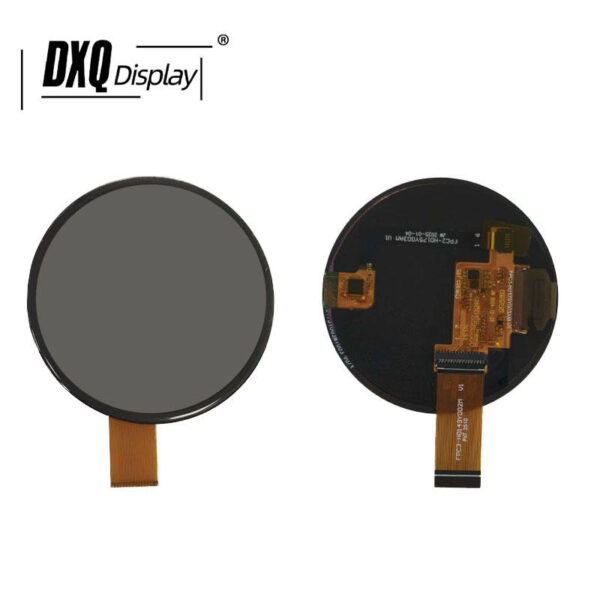
The 1.75 Inch 466×466 Round AMOLED Display combines high pixel density, On-Cell touch integration, and the energy-efficient CO5300 driver IC.
Crisp 466×466 Pixel Grid with Ultra-High Brightness
Engineered with a high-density four hundred sixty-six by four hundred sixty-six pixel array, this panel renders delicate visual details smoothly. The self-emissive architecture produces seven hundred cd per square meter brightness alongside a stunning one hundred thousand to one contrast ratio. Furthermore, check out our detailed technical-guide regarding QSPI interface initialization, On-Cell touch driver integration, and low-power sleep state configurations.
Ultra-Thin On-Cell Touch Structure for Fluid Interaction
Integrating On-Cell capacitive touch sensors directly into the display stack yields a slim zero point eight millimeter module thickness. High optical transparency enhances screen clarity, while responsive touch performance provides buttery-smooth UI swiping and tapping feedback. Consequently, wearable designers create ultra-slim, lightweight smartwatch enclosures that contour comfortably around human wrists during daily wear.
Optimized CO5300 Driver IC with QSPI Data Bus Efficiency
Powered by the dedicated CO5300 driver IC, this module supports flexible QSPI and MIPI interface protocols smoothly. The efficient 31-pin FPC connector simplifies circuit board design while preserving precious battery power across always-on display modes. Additionally, direct factory production pricing delivers enterprise-grade wearable display hardware at an extraordinarily accessible, budget-friendly acquisition cost.
Technical Specifications & Display Technology Comparison
The chart below compares our 1.75 Inch Round AMOLED Display against standard circular LCDs and basic passive OLED panels.
| Specification Parameter | 1.75 Inch Round AMOLED Module | Standard Circular LCD Module | Basic Passive OLED Screen |
| Display Technology | Active Matrix AMOLED | Transmissive TFT-LCD | Passive Matrix OLED |
| Pixel Resolution | Four Hundred Sixty-Six Grid | Three Hundred Sixty Grid | Two Hundred Forty Grid |
| Peak Brightness | Seven Hundred cd per sq meter | Three Hundred cd per sq meter | One Hundred Fifty cd per sq meter |
| Contrast Ratio Rating | 100000 to 1 Ultra-High | 800 to 1 Standard Ratio | 2000 to 1 Basic Contrast |
| Touch Architecture | Integrated On-Cell Touch | External Glass Air-Gap Touch | Non-Touch or External Film |
| Module Thickness | Zero Point Eight Millimeters | Two Point Zero Millimeters | One Point Five Millimeters |
| Driver Bus Interface | Fast QSPI / MIPI Interface | Legacy RGB / SPI Interface | Basic Parallel Bus Interface |
| Cost Performance | High Value (Premium Quality) | Low Value (Bulky Profile) | Low Value (Low Resolution) |
Versatile Deployments Across Smart Wearable Electronics
Consider these primary commercial deployment scenarios when integrating circular AMOLED display modules into your hardware lineup today.
- Flagship Smartwatches: Ultra-high resolution and vivid color output create luxurious watch faces that rival traditional high-end horology.
- Outdoor Sports Watches: Seven hundred cd per square meter brightness guarantees instant legibility for runners and cyclists under direct sunlight.
- Health & Medical Wearables: Crisp pixel density renders complex continuous ECG waveforms and blood oxygen telemetry curves with absolute precision.
- Industrial IoT Wearables: Wide operating temperatures from minus twenty to plus seventy degrees Celsius ensure reliable field operation for workers.
Upgrade your wearable display performance and achieve the ultimate hardware investment value today! Browse our wide product-category selection to order your circular AMOLED modules now.



Add comment