

A flexible screen display helps wearable manufacturers create slimmer, more comfortable, and visually engaging products. Today, flexible AMOLED technology supports curved surfaces, vivid colors, and integrated touch functionality. Moreover, designers can align the display with compact wearable enclosures. These benefits matter for smart bands, smartwatches, smart glasses, and wearable terminals.
However, successful integration requires more than a bendable panel. Engineers must consider dimensions, brightness, interface compatibility, and mechanical constraints. Therefore, choosing a suitable flexible screen display helps balance appearance, usability, and production requirements.

How Can a Curved Wearable Display Improve Comfort?
Traditional flat display layouts can constrain wearable enclosure designs. For example, wrist-worn devices often benefit from narrow, elongated screens. Meanwhile, curved housings require careful coordination between display geometry and mechanical structure.
Flexible AMOLED Technology Supports Curved Designs
A flexible AMOLED display uses a flexible substrate to support curved product designs. Consequently, engineers gain more freedom when developing wrist-fitting enclosures and slim wearable profiles.
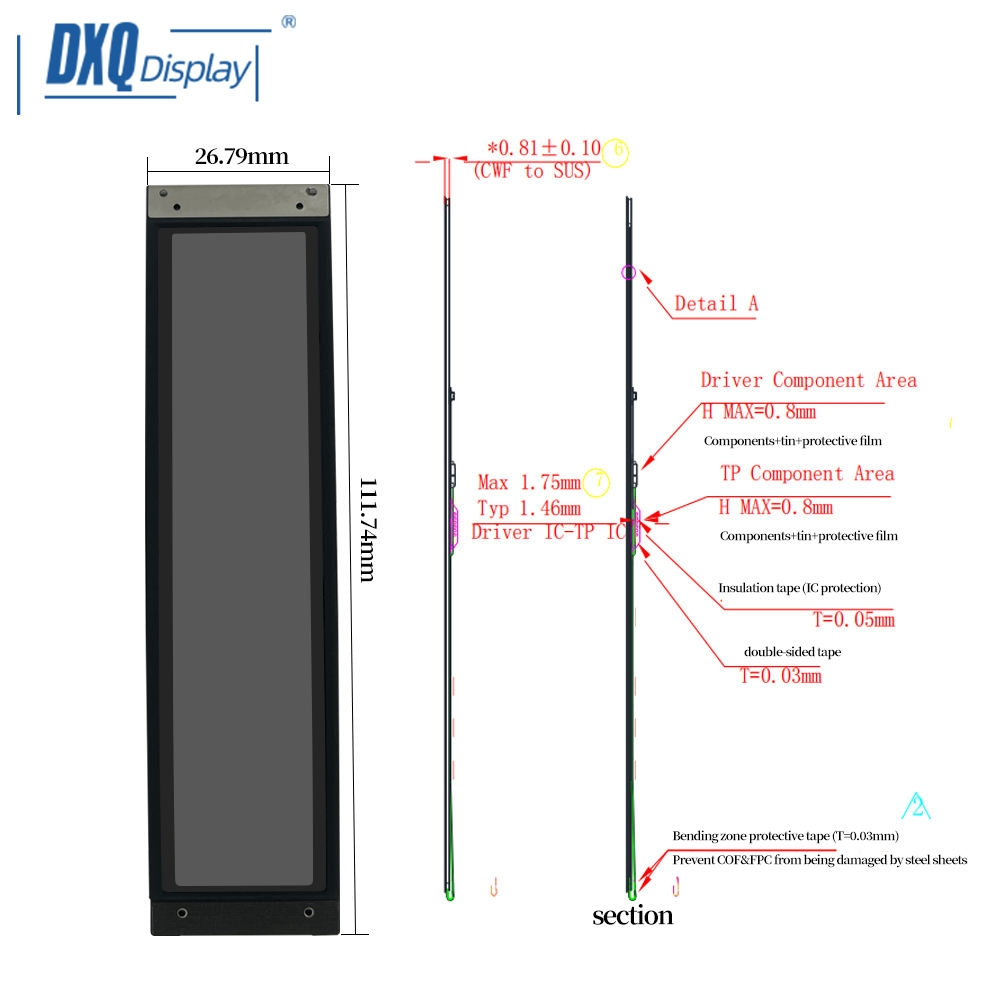
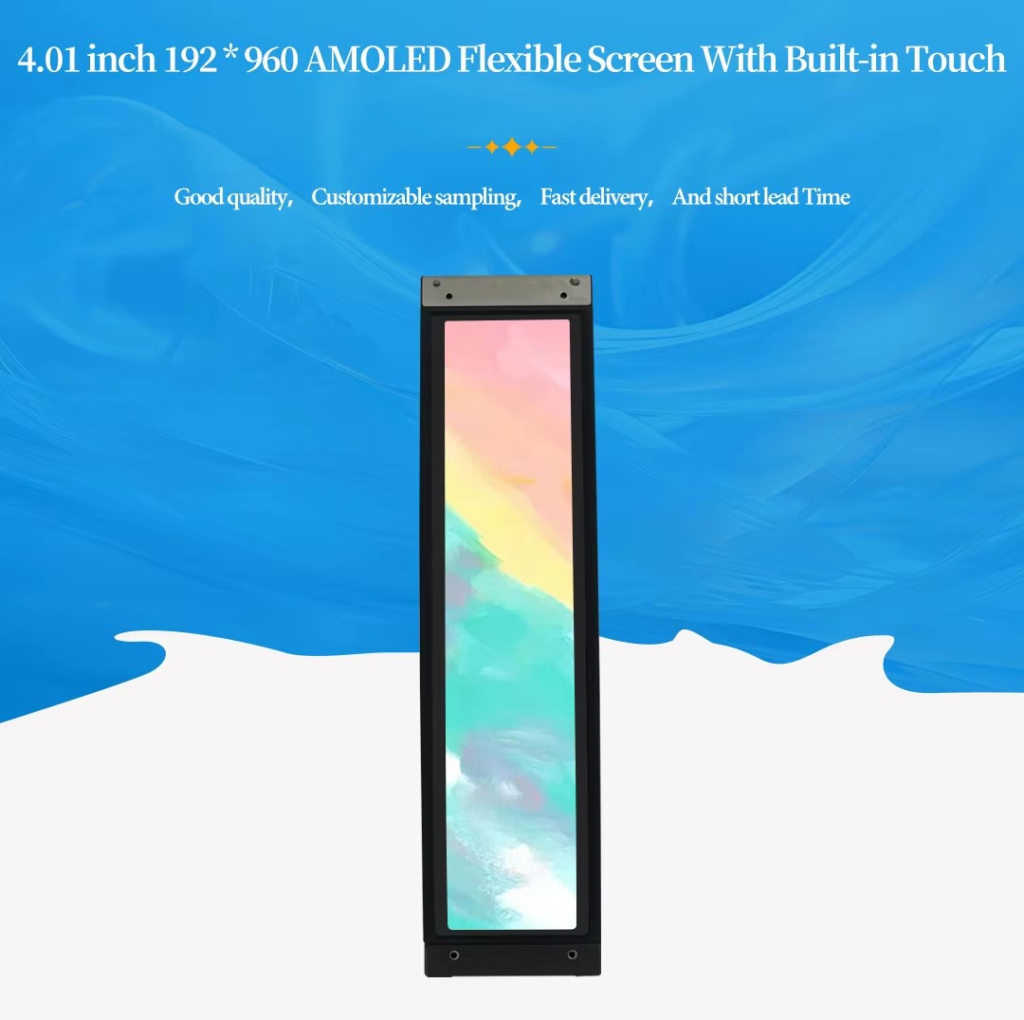
Consider a 4.01-inch bar-type AMOLED display with an outline thickness of 0.81 mm. Its compact profile supports space-conscious wearable designs. Additionally, its outline dimensions measure 27.39 mm × 111.74 mm.
The active area measures 19.99 mm × 99.94 mm. This elongated format suits narrow interfaces with vertically arranged information. Therefore, designers can organize notifications, activity metrics, and controls within a tall screen layout.
However, developers must validate the permitted bending radius with the supplier. They should also check mounting stress and enclosure tolerances before production. A flexible substrate does not guarantee unlimited bending or repeated deformation.
Can a Flexible Screen Display Improve Small-Screen Readability?
Wearable interfaces often present information within limited screen areas. Consequently, designers must prioritize clear typography, visible icons, and efficient layouts. Small displays also require thoughtful contrast management and appropriate brightness settings.
AMOLED Contrast Supports Clear Visual Presentation
AMOLED pixels generate their own light, supporting deep blacks and strong image contrast. As a result, interfaces can present distinct visual elements against dark backgrounds.
The specified display provides a 192 × 960 pixel resolution. Its pixel density reaches approximately 244 pixels per inch. Therefore, designers can arrange text, icons, and compact interface elements with useful detail.
The listed brightness reaches 350 cd/m². This level can suit many indoor wearable applications and controlled lighting conditions. However, outdoor readability also depends on reflections, cover glass, viewing conditions, and interface design.
The specified contrast ratio is 17,500:1 in the repeated product details. Please confirm this value before publishing, since another supplied specification lists 175,000:1.
Moreover, designers should test actual interface content under representative lighting conditions. They should evaluate font sizes, icon spacing, and background choices. These checks help ensure practical readability across intended use scenarios.

How Does a Flexible AMOLED Display Improve Touch Interaction?
Wearable devices increasingly combine visual feedback with direct touch controls. However, limited screen space makes accurate interaction particularly important. Therefore, display and touch integration should support the intended user interface.
On-Cell Capacitive Touch Simplifies Integration
This 4.01-inch flexible screen display integrates On-Cell capacitive touch functionality. Consequently, product teams can evaluate a combined display-and-touch solution during enclosure development.
The module uses a 30-pin connector and a MIPI interface. Engineers must verify connector mapping, signal requirements, and host-controller compatibility. The MIPI Alliance also identifies smartwatches and head-mounted devices among relevant display-interface applications.
In practice, MIPI compatibility depends on the actual host implementation. Teams should confirm lane configuration, timing, resolution support, and driver availability. Furthermore, touch communication requires its own controller and firmware validation.
For early development, teams should test touch accuracy across the intended active area. They should also assess performance near curved edges. These checks help identify integration issues before tooling and mass production.
Explore our flexible display product category to review display formats for different wearable concepts.
Which Flexible Screen Display Specifications Matter Most?
A suitable panel must match both the product concept and its operating environment. Therefore, procurement and engineering teams should review mechanical, optical, electrical, and thermal requirements together.
Key Specifications for Wearable Integration
The following table summarizes the supplied module specifications and their practical implications.
| Parameter | Specification | Design Relevance |
|---|---|---|
| Display type | Flexible AMOLED | Supports curved wearable layouts |
| Screen size | 4.01 inches | Suits elongated wearable interfaces |
| Resolution | 192 × 960 pixels | Supports vertically arranged content |
| Pixel density | Approximately 244 PPI | Helps render detailed interface elements |
| Brightness | 350 cd/m² | Supports indoor and controlled-light use |
| Contrast ratio | 17,500:1, pending confirmation | Supports distinct light and dark content |
| Viewing angle | 85°/85°/85°/85° | Confirm measurement conventions with the supplier |
| Touch technology | On-Cell capacitive touch | Integrates touch sensing into the display assembly |
| Interface | MIPI | Requires host-side compatibility verification |
| Connector | 30 pins | Requires matching connector and pin assignment |
| Outline dimensions | 27.39 mm × 111.74 mm × 0.81 mm | Supports compact, elongated enclosure layouts |
| Operating temperature | -20 °C to +60 °C | Defines the specified operating range |
| Storage temperature | -30 °C to +70 °C | Defines the specified storage range |
| MOQ | 2 pcs | Supports initial evaluation orders |
| Sample lead time | 7 days | Supports early development planning |
| Mass-production lead time | 25–30 days | Supports preliminary manufacturing schedules |
| Certifications | Not specified | Confirm applicable compliance documentation separately |
The temperature limits define the specified environmental range, not guaranteed performance under every condition. Likewise, production lead times should be reconfirmed against current order requirements.
For integration planning, teams should also review power consumption and mechanical durability. These figures were not provided in the current specifications. Therefore, request supporting documentation before finalizing the design.
Read our display technical guides for additional guidance on interface selection and module integration.
How Can Manufacturers Reduce Flexible Display Integration Risks?
Flexible screen displays offer valuable design options, but early validation remains essential. First, confirm the active area and outline dimensions against the enclosure drawing. Next, verify the display driver, connector pinout, and MIPI communication requirements.
Meanwhile, evaluate brightness under expected lighting conditions. Test touch response with the intended cover materials and user interface. Additionally, review bending limits and assembly procedures with the supplier.
The specified operating temperature spans -20 °C to +60 °C. Nevertheless, complete wearable qualification requires more than temperature verification. Teams should assess humidity exposure, mechanical stress, electrical stability, and product-specific reliability requirements.
For sourcing teams, sample availability can also support faster evaluation. This module lists a minimum order quantity of two pieces. Its stated sample lead time is seven days, while mass production requires approximately 25–30 days.
However, actual schedules depend on confirmation and production conditions. Therefore, request a current quotation, finalized specifications, and relevant compliance documents before placing larger orders.
Q&A
Q1: Which wearable products suit this flexible screen display?
The 4.01-inch module suits smart bands, smartwatches, smart glasses, and wearable terminals. Its elongated format supports vertically arranged information. However, designers should verify the available space and viewing requirements for each product.
Q2: Can this AMOLED display fit a curved enclosure?
Its flexible substrate supports curved design concepts. Nevertheless, the permissible bending radius and assembly restrictions require supplier confirmation. Engineers should also validate mechanical stress throughout the planned assembly process.
Q3: What should buyers confirm before ordering samples?
Buyers should confirm the 192 × 960 resolution, MIPI interface, and 30-pin connector. Additionally, verify the contrast ratio discrepancy and applicable certifications. Finally, confirm sample availability, lead time, and the intended application requirements with the supplier.



Add comment