
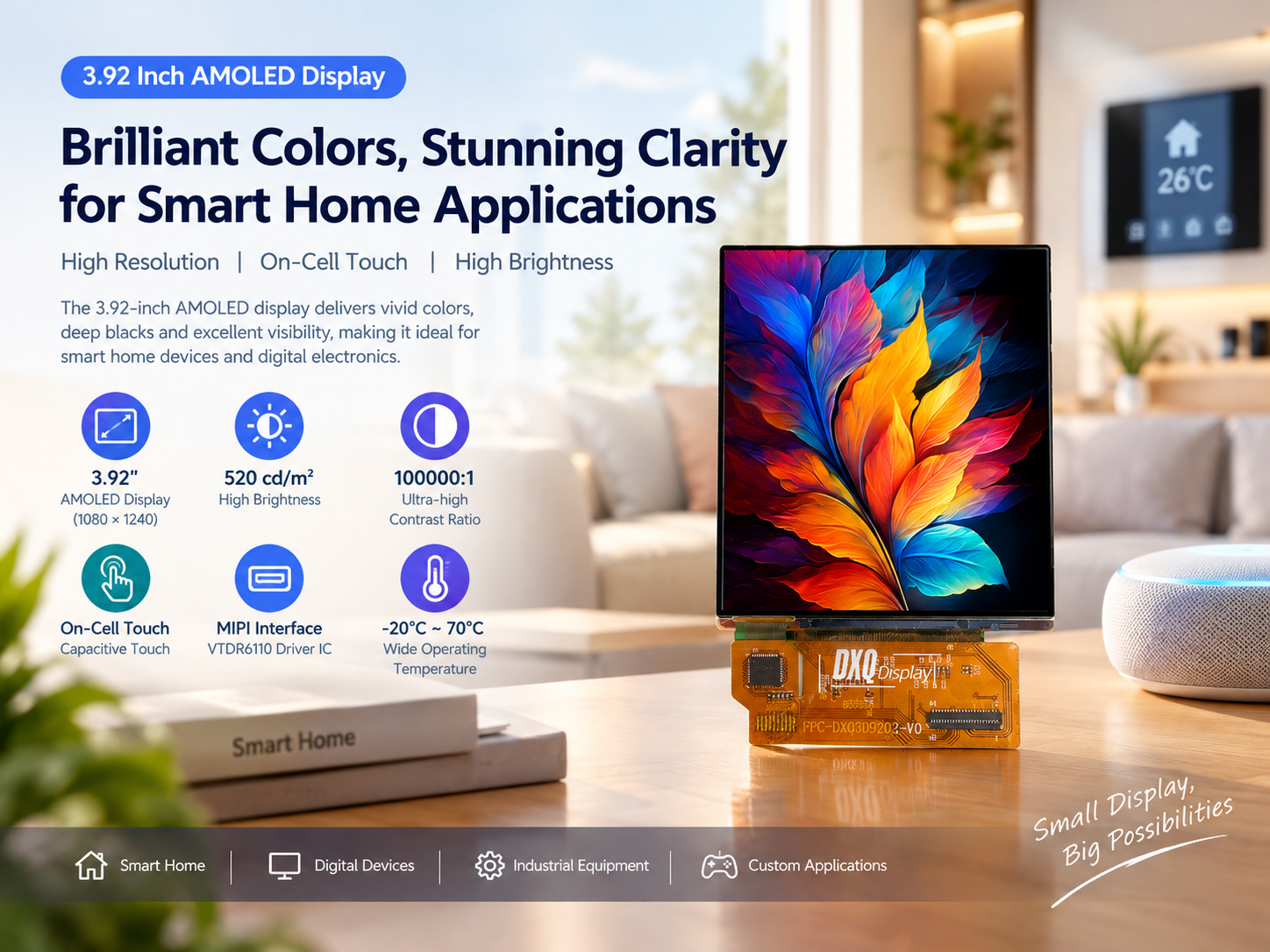
A Custom AMOLED Manufacturer helps OEM teams align display performance, touch integration, and mechanical design with device requirements. For compact smart-home products, the process often involves panel selection, interface matching, and validation before mass production. The DXQ3D9202 module provides a practical example.

Why Do OEM Displays Need More Than Standard Specifications?
A display may meet resolution and brightness targets yet still conflict with a device’s housing, connector position, or mainboard. Therefore, OEM teams should confirm electrical and mechanical requirements before finalizing a display module. A custom AMOLED display project should define viewing area, outline dimensions, interface, touch behavior, operating temperature, and assembly constraints early.
Solution: Align Mechanical and Electrical Requirements
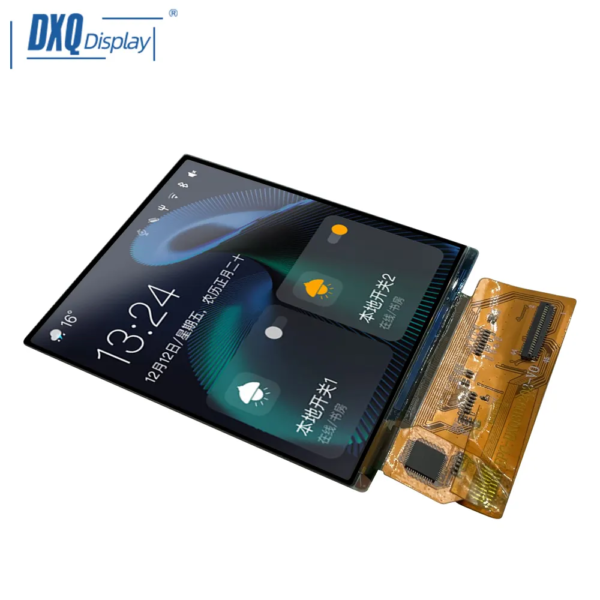
The DXQ3D9202 uses a 3.92-inch display with a resolution of 1080 × 1240 pixels. Its outline measures 67.25 mm × 79.87 mm, while its thickness is 0.78 mm. Meanwhile, the 45-pin connector and MIPI interface must match the target device’s circuit design. In practice, a Custom AMOLED Manufacturer can review these details with the OEM team before sample integration.

How Can On-Cell Touch Integration Simplify Compact Device Design?
Separate touch layers and display components can affect module thickness and assembly planning. In contrast, On-Cell capacitive touch integrates touch sensing into the display structure. Still, final suitability depends on the device’s stack-up and touch requirements.
Solution: Validate the Touch Controller and Host System
The DXQ3D9202 combines On-Cell capacitive touch with a compact display structure. In addition, the supplied specification identifies a VTDR6110 display driver and two possible touch-controller references. Therefore, the engineering team should confirm the final controller part number before approval.
OEM teams should then verify touch response, firmware compatibility, noise behavior, and operation through the intended host system. This process helps confirm compatibility before production begins.
How Can Display Specifications Support Clear, Detailed Interfaces?
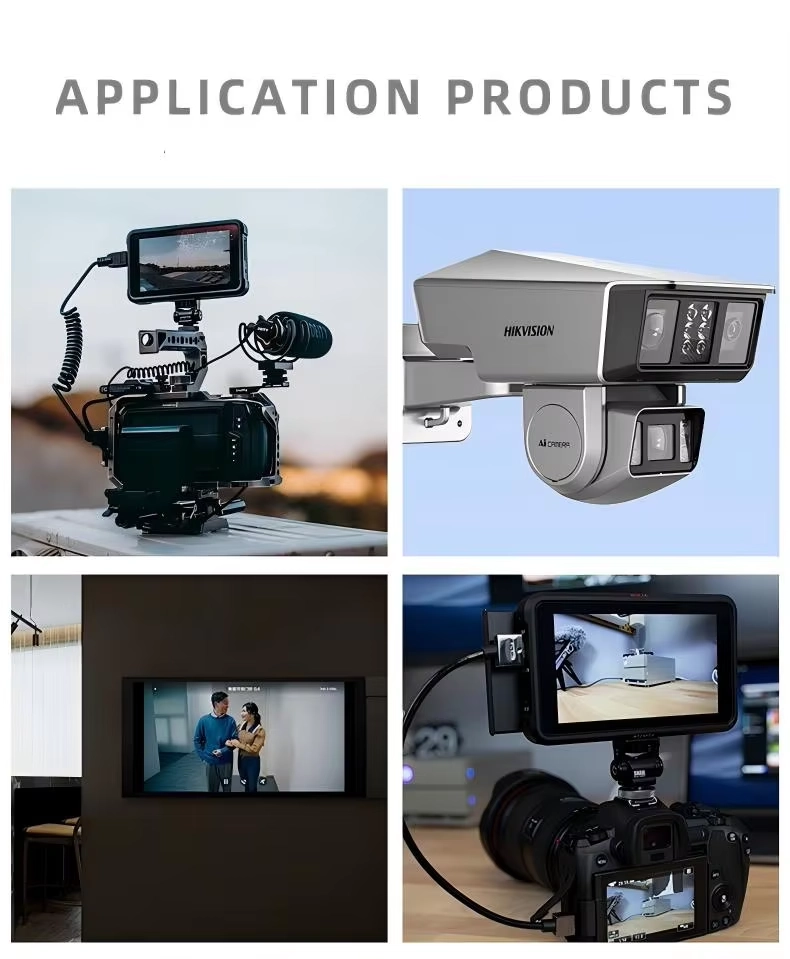
Smart-home panels and embedded interfaces often combine icons, text, status graphics, and controls. Therefore, buyers should assess display performance against the actual viewing environment rather than relying on a single specification. For example, brightness, contrast, resolution, and viewing angle all affect how the interface appears.
Solution: Match the Panel to Real Operating Conditions
The panel specifies 520 cd/m² brightness and a 100,000:1 contrast ratio. It also offers a resolution of 1080 × 1240 pixels and a full viewing angle described as IPS-level.
These figures guide design review. However, engineers should test readability under expected ambient lighting. They should also confirm that the display area, interface layout, and color rendering suit the final application.
For this purpose, a Custom AMOLED Manufacturer should review the target device’s viewing conditions and display requirements. This process helps engineering teams assess the module before finalizing the product design.
How Can OEM Buyers Reduce Sample and Production Risk?
A prototype that works once does not automatically confirm production readiness. Consequently, OEM projects should define acceptance criteria before approving samples. Teams should check fit, touch operation, signal integrity, thermal behavior, and assembly repeatability.
In addition, they should agree on configuration control before placing volume orders. These steps help identify design issues earlier and create a clearer path toward production.
Solution: Use Staged Validation and Clear Production Planning
The stated sample lead time is seven days, while mass production typically requires 25–30 days. The minimum order quantity is two pieces, which supports early evaluation in small project batches.
Nevertheless, buyers should confirm lead times against the approved specification, component availability, and order schedule. For steady supply, record the bill of materials, connector details, test criteria, and approved custom changes.
A Custom AMOLED Manufacturer can then use this record to manage revisions and keep project teams aligned. This approach supports clearer communication between engineering, procurement, and production teams.
Explore our AMOLED display modules to review display options for different device designs.
DXQ3D9202 AMOLED Module Specifications
| Parameter | Specification |
|---|---|
| Model | DXQ3D9202 |
| Display type | AMOLED |
| Diagonal size | 3.92 inches |
| Resolution | 1080 × 1240 pixels |
| Brightness | 520 cd/m² |
| Contrast ratio | 100,000:1 |
| Touch technology | On-Cell capacitive touch |
| Interface | MIPI |
| Display driver IC | VTDR6110 |
| Touch controller | Confirm final configuration |
| Connector | 45-pin |
| Outline dimensions | 67.25 mm × 79.87 mm × 0.78 mm |
| Operating temperature | −20 °C to +70 °C |
| Minimum order quantity | 2 pieces |
| Sample lead time | 7 days |
| Mass-production lead time | 25–30 days |
Engineering note: The supplied product information lists both CST3640 and FT3519 as touch-controller references. Confirm the approved part number before publishing the final specification or beginning integration.
Read our display integration technical guide for practical guidance on interface matching, mechanical fit, and prototype validation.
Q&A
Q1: What should an OEM share with a Custom AMOLED Manufacturer?
Provide the target device dimensions, interface requirements, touch behavior, operating conditions, and expected production volume. Additionally, share a schematic or connector definition when available. These details help the engineering team evaluate compatibility and identify potential integration issues early.
Q2: Can the DXQ3D9202 support compact smart-home devices?
Its 3.92-inch format, On-Cell touch, and 0.78 mm profile may suit compact interfaces. However, the engineering team should verify mounting, electrical compatibility, and user-interface requirements. Final suitability depends on the complete device design.
Q3: How long do samples and mass production take?
The stated sample lead time is seven days, and mass production takes 25–30 days. However, actual schedules depend on specification approval, component availability, and order requirements. Buyers should confirm the schedule before placing an order.
Q4: What should teams confirm before ordering?
Confirm the touch-controller part number, MIPI configuration, connector pinout, mechanical drawing, and operating-temperature requirements. Finally, approve a representative sample against documented acceptance criteria before proceeding with the production order.



Add comment